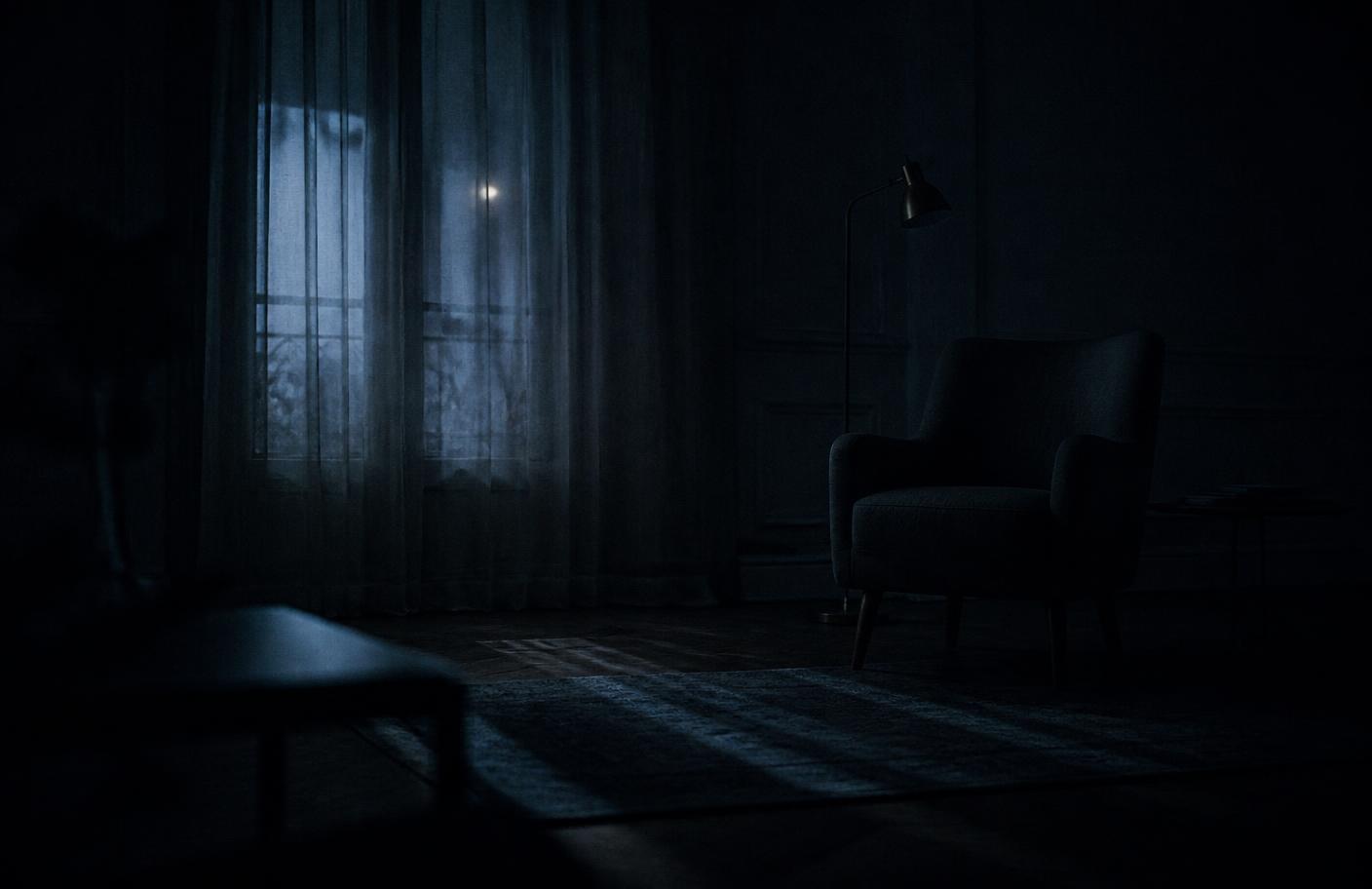
I was standing in the middle of my living room at three o'clock in the morning.
I hadn't planned to be there. I'd woken up and something had come to a head, and I found myself standing in the dark asking questions I had never seriously asked myself before.
Who am I?
Where am I going?
What is this all about?
For most people that might not sound remarkable. For me it was confronting, because I have always been the positive one. The energetic one. The person with the next idea already forming. Standing in a dark room at three in the morning with no answer to the question of my own future was not me.
I was sixty-nine years old. I had built a couple of businesses, employed people, spent fifty years becoming good at something, and I could not see a future for myself.
Those three questions have since become the foundation of everything you will read on this site. They are the questions at the heart of the Human Potential Ecosystem. I did not choose them because they sounded good in a document.
I chose them because they were the only three questions I had left.
How I Got There
I never intended to spend thirty-six years doing work that drained me. Almost nobody does.
When I was a boy and adults asked what I wanted to be, I said an airline pilot. Or a doctor. I had no idea what either job actually involved — whether sitting in a cockpit or across from patients would suit me at all. An airline pilot, I can see now, is probably a bit like driving a bus in the sky; I'd have been bored within a year, after a decade qualifying for a life that didn't fit me.
I was fortunate that I didn't get in.
Many people aren't. They qualify, they commit, they take on a mortgage, and by the time they realise the work doesn't suit them they're locked in — not because they lack ability, but because they made a decision at seventeen about a person they hadn't met yet.
I left school without knowing what I wanted, but knowing I wanted a qualification. My father had trained in both mechanical and electrical engineering, so I followed him into it and qualified in mechanical engineering in 1977. It didn't really suit me. There was one part of it I liked — automating machines — but this was the 1970s, and back then that meant pneumatics and hydraulics. Electronics was only beginning to take hold. So a year into working, I went back to university and studied electronics engineering part time — seven years of it, alongside a full-time job — and came out an electronics engineer, which suited me far better. From there I moved into robotics and industrial automation.
In 1986, after about eight years working for others, I started my own company building industrial automation systems, and I loved it. I was designing the hardware, writing the operating systems, building the microcontrollers — making things that had not existed before. I was completely energised by it.
Then it ran out of money.
In 1989 an opportunity came up to start a small side business to fund the work I was passionate about. Within a short time the side business was the business, and the passion was gone.
I spent the next thirty-six years running that company.
The Realisation
Over those decades I had a great many ideas. One of my closest friends used to say to me, “Mark, for goodness sake, finish something before you start another.”
He wasn't wrong. I rarely finished anything. But I think he mistook the symptom for the fault. It wasn't that I couldn't finish — it was that finishing was never the part that interested me. The work of commercialising an idea — the capital, the team, the market, the years of execution — was a barrier I had no way over. So the ideas stayed ideas. Almost none of them made it into the world.
What I understand now is that those ideas would have died with me.
Every one of them. Fifty years of thinking, buried with the person who thought it — not because they lacked value, but because I never had the resources to bring them out.
By my late sixties I was burnt out. My friends and family were retiring, most of them from jobs that had exhausted them, counting down to the day they could stop. I couldn't afford to retire, so I kept going.
That is how I ended up standing in my living room in the dark.
What GeniusFlow Told Me About Myself
A few months later I built the first version of GeniusFlow — a tool for uncovering where a person naturally comes alive. It took less than 100 hours to build the first version, sitting on top of fifty years of experience.
I was one of the first people to use it.
I expected it to tell me something reassuring. I'm a robotics engineer. I've run technology businesses for forty years. Any conventional assessment would have looked at that and declared a match.
Instead it told me the thing my friend had misread all those years earlier. My strength isn't finishing, and it isn't technology. It's creation. And the business I had spent thirty-six years running had almost no creation in it.
We installed computer networks. We built wireless networks for companies and councils. We supplied and maintained security camera systems across Victoria. There was a great deal of sophisticated technology involved — file servers, wireless backhaul, camera systems.
But every single piece of it was somebody else's creation.
For thirty-six years my job had been to assemble other people's creations for my customers. There was nothing in it that hadn't existed before I arrived. That was why it drained me. Not the technology — the absence of creation.
I'd had the freedom to take any role in that business, and over the years I held nearly all of them — administration, marketing, sales, design, project management, leadership. I never found the one that fitted, because the thing I needed wasn't a role. It was the act of making something new.
I had been circling this for years without knowing it. I became fascinated by the concept of flow and, in particular, whether you could help an entire team work in flow rather than just one person. I studied Csíkszentmihályi, trained as a certified flow consultant, and eventually began developing my own approach when I found the existing models didn't quite answer the question I was trying to solve. I later wrote about those ideas in Build To Exit.
I kept coming back to the problem, year after year, but I never had the resources, the team or the money to bring the tool I imagined to life.
The idea was simple, even if implementing it wasn't: help people spend more of their time doing the work that energised them, then build the right team around them to handle the rest.
It took a tool I finally built myself, at sixty-nine, to tell me the answer had been sitting in my own working life the entire time.
My Father
My father demonstrated the same principle, and I only recognised it afterwards.
At sixty-eight — an age at which most people are winding down — he began developing a Magnetically Impelled Arc Butt Welding system for gas and oil pipelines. The technology drew on more than fifty years across mechanical engineering, electronics, electrical engineering, structural engineering, plasma physics, automation and manufacturing. It wasn't the result of a single good idea. It was the visible expression of an entire lifetime. He achieved something that large companies with far greater resources had been attempting, unsuccessfully, for decades.
Someone once asked him what would happen if a competitor copied it.
He said: “It doesn't matter. I already have the next ten inventions in my head.”
The invention could be copied. The lifetime that produced it could not.
I didn't understand what I was looking at when he did it.
I understand it now, because I am doing the same thing.
What Changed
I have just turned 70. Six months ago I was burnt out and would have retired if I could have afforded to.
Today, I have never been more energised in my life. I am more productive now than I have been at any point in fifty years of work.
My age didn't change. My alignment did.
Two things made it possible. The first was finally understanding where my energy actually comes from. The second was artificial intelligence — not because it became clever, but because it removed the barrier that had killed every idea I ever had.
I no longer need capital, a team and three years to find out whether an idea is worth building. I can build it. The ideas that would have died with me are becoming real, and almost every one of those abandoned ideas has found a home somewhere inside the Human Potential Ecosystem.
I should be honest about one thing. I built this to solve my own problem, and I was its first subject. That isn't evidence — one person never is. It's simply the reason I believe it's worth putting in front of people who aren't me.
Why It Matters Beyond Me
I spend a lot of time in the Philippines. My partner is from there, and I run a business there. You cannot spend time in a developing nation without being struck by the gap between wealth and poverty — it is far starker than anything we see in Australia, where even people doing it tough usually have healthcare, social security and some measure of opportunity.
For years I thought the answer was to move wealth from the top to the bottom. When I ran workshops for my team there, I used to talk about the champagne glass — a small group at the top holding most of the world's wealth, a thin middle, and a very large base living from one pay cheque to the next. Narrow the glass, I argued, and everyone gains.
I talked about it for years and did nothing about it. And I have come to think I had the problem the wrong way round.
The wealth I most want to release isn't being held by anyone. It isn't in a bank account, and it doesn't have to be taken from one person before it can reach another.
It is sitting inside people's heads.
It was sitting inside mine—fifty years of accumulated experience, ideas and creativity—and it is only now beginning to emerge. I am not unique. There are nearly eight billion people on this planet carrying the same invisible wealth: ideas, experience, judgement, creativity and solutions to problems nobody else has noticed.
Most of it will never be realised. Not because it lacks value, but because the people carrying it never discover it, never believe in it, or never have the tools to bring it into the world.
We are not redistributing wealth that already exists. We are creating new wealth out of the one resource we have never learned to draw on — the potential inside ordinary people.
That isn't a problem of distribution. It's a problem of loss.
That is what this ecosystem is for.
The Invitation
The Human Potential Ecosystem is new. The thinking behind it is sitting on fifty years.
What I'm inviting people into isn't simply a piece of software.
It's a Human Potential World built around the person — a place designed to help people understand themselves, discover what energises them, explore what might be possible, and surround themselves with the guidance and capability to do something about it.
Behind it is something much more personal.
It's what happened to me in the months after that night in my living room. I didn't recover quickly. I was at rock bottom, and I stayed there for a while. What eventually changed wasn't willpower. It was the recognition that fifty years of twists, failures and wrong turns had assembled someone capable of this work — and the discovery that at seventy the tools finally exist to do something with it.
I don't think that was destiny. A different decision at twenty-five and I'd be looking back on an entirely different life, finding an entirely different pattern in it. I suspect my father was the same. What I do believe is that the pattern was real — and that most people never get to see theirs.
For most of my life, that recognition would have come too late to matter.
The ideas would have stayed in my head, and fifty years of experience, thinking and possibility would eventually have gone quietly with me.
That is the loss I don't want other people to have to accept.
Because for the first time in history, many of the barriers that kept ordinary people from turning what was inside them into something real are beginning to disappear.
And it doesn't matter where you are in your own fifty years. Whether you're just starting out, somewhere in the middle, or close to the point where everyone expects you to stop — when you discover the thing that energises you, and can turn your attention to it, life changes.
Imagine what becomes possible when millions of people discover what energises them, understand what they uniquely have to offer, and gain access to the capability to bring it into the world.
I know what that change has done for me.
At seventy, I don't feel as though I'm winding down.
I feel as though I'm just getting started.
And if enough people discover that their greatest contribution may still be ahead of them, the world becomes an extraordinary place.
That is the whole reason I am here.
— Mark Stecher, Founder